
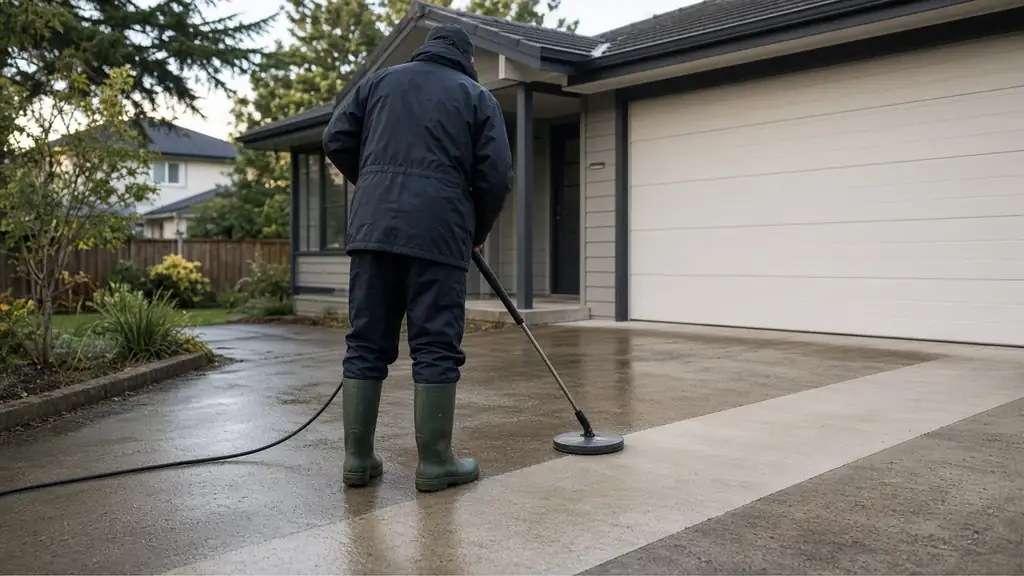
Water blasters are great tools. They're also the reason we get calls about stripped paint, furry deck boards and water stains inside walls. The machine isn't the problem. Pointing it at the wrong thing is.
Here's where a water blaster earns its keep around an Auckland home, where it does damage, and what we use on the bits that can't take it.
Yes, it can do damage
A water blaster works by hitting a surface with a narrow, high-pressure jet. On hard, unpainted surfaces like concrete, that's exactly what you want. On anything softer, painted or full of joins, that same jet can cause trouble.
The damage usually isn't obvious on the day. The house looks clean. The problems show up weeks or months later.
Painted weatherboards
High pressure lifts paint, especially paint that's already chalky or a bit tired. It finds every small crack and peels from there. It can also gouge the timber itself, leaving a fuzzy, raised grain that won't take new paint nicely.
Worse, it can drive water up and in behind the laps of the weatherboards. That moisture sits in the wall framing. In a city as humid as Auckland, damp framing is the start of rot and mould you can't see.
Plaster and monolithic cladding
Plenty of Auckland homes from the 1990s and 2000s have plaster or other monolithic cladding. These systems rely on seals, flashings and joins to keep water out. Blasting at those joins is asking for trouble. If water gets in behind, it can sit there for a long time before anyone knows.
These houses should only ever get a low-pressure wash.
Window joinery and seals
Aluminium joinery has rubber seals and drainage gaps. Old timber windows have putty and paint. High pressure can blow out seals, crack old putty and force water past the frame into the wall or onto the sill inside.
Roofs
Pressure washing is fine on some roofs, like long-run iron and concrete tiles, when it's done by someone who knows how. On roofs with a chip coating such as Decramastic, high pressure strips the stone chip off and shortens the life of the roof. Shingle-style roofs can lift and come loose.
Walking on a wet roof with a lance in your hand is also a good way to end up in hospital.
Timber decks and fences
Softwood decking and fence palings mark easily. Too much pressure, or holding the nozzle too close, leaves stripes and a furry surface that looks worse when it dries. It also opens the grain so the timber greys and grows mould faster.
Decks can be water blasted, but with a lower setting, a wider fan and the right technique. Often a soft wash with a cleaning solution does a better job of killing the green algae without roughing up the boards.
Where water blasting is the right call
There's plenty around a home that a water blaster handles well:
- Concrete driveways and paths
- Brick and pavers
- Stone and exposed aggregate, with care
- Asphalt
- Concrete retaining walls
These are tough, unpainted surfaces where the pressure lifts moss, oil and grime without harming the surface. Even here, technique matters. Hold the nozzle too close on concrete and you'll etch lines into it. Very new concrete, less than about three years old, shouldn't be pressure washed at all. Soft wash it instead. See our pressure washing in Auckland page for the surfaces we water blast.
What we use on the house instead
For walls, eaves, joinery and roofs, we soft wash. That means low pressure, about like a garden hose, plus a cleaning solution that kills mould, lichen and algae at the roots. The solution does the work, not the pressure. We let it sit, then rinse it off.
Because the growth is actually killed, it doesn't come straight back the way it does after a blast with plain water. You can read more about it on our soft wash Auckland page, or see what's included in a full house wash in Auckland.
If you're doing it yourself
If you've hired a water blaster for the weekend, a few rules will keep you out of strife:
- Keep it off painted walls, windows and the roof
- Start with the lowest setting and the widest fan nozzle
- Test a small hidden spot first
- Keep the nozzle a good distance from the surface and keep it moving
- Never point it upward under weatherboard laps or flashings
- Don't let detergent run into the stormwater drain
If you've already blasted the house and noticed lifting paint or damp patches inside, get the paint and the wall checked before winter.
What it costs
Water blasting is priced by area and how bad the surface is. We'll give you a free quote before we start. Call us on 027 303 8398, seven days, 7am to 7pm.
Water blasting questions
Is it safe to water blast my house?
Not the walls, joinery or most roofs. We soft wash those with low pressure and a cleaning solution. Water blasting is for hard, unpainted surfaces like concrete and brick.
Can water blasting remove paint?
Yes, and that's the problem. High pressure lifts tired or chalky paint. It's sometimes used on purpose for prep work, but on a house you want to keep painted, it's a risk.
Can I water blast new concrete?
Concrete under about three years old should be soft washed instead. High pressure can damage the surface while it's still curing and hardening.
Why does mould come back after water blasting?
Plain water knocks off what you can see but doesn't kill the roots. A soft wash solution kills the growth, so it stays away much longer.