
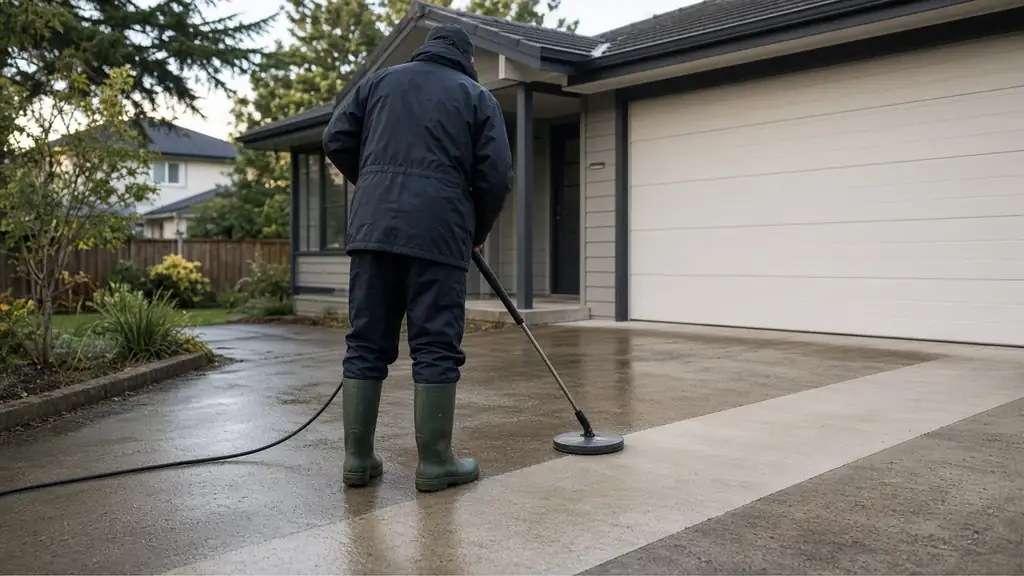
A pressure washer is one of the best tools for cleaning up around a house. It's also one of the easiest to wreck things with. The trick is knowing which surfaces can take it.
Here's a surface-by-surface guide for Auckland homes, from the driveway to the fence line.
Concrete driveways and paths: yes
This is what pressure washing is made for. Auckland's damp winters leave driveways and paths green, grey and slippery, especially on the shady side of the house. A pressure washer lifts moss, algae, dirt and tyre marks and brings the concrete back to its original colour.
Two things to watch. Keep the nozzle moving at a steady distance, or you'll etch stripes into the surface. And if the concrete is less than about three years old, don't pressure wash it at all. Soft wash it instead, because the surface is still hardening.
For oil stains, a degreaser needs to go on first. Pressure alone rarely shifts old oil. See our driveway and concrete cleaning page for more on stains.
Exposed aggregate: yes, with care
Exposed aggregate looks great clean, but too much pressure can loosen stones, particularly on older or poorly sealed surfaces. Use a wider fan, a lower setting and don't hold the jet in one spot. If it's been sealed, check how the sealer is holding up before you start.
Pavers and brick paving: yes, with care
Pavers clean up well, but the joints are the weak point. Blast straight down the gaps and you'll wash out the sand that holds them in place. Work at an angle, then brush fresh joint sand back in once it's dry.
Timber decks: carefully, or soft wash instead
Decks are where a lot of DIY jobs go wrong. Pine and other softwoods mark easily. Too much pressure leaves a furry, raised grain and stripes you can see from the house.
Decks can be pressure washed at a low setting with a wide fan, working along the boards. But often the better option is a soft wash. A cleaning solution kills the green algae and black mould, then a gentle rinse takes it away without roughing up the timber. Either way, let it dry fully before oiling. Read more on our deck washing page.
Composite decking: check first
Composite boards each have their own care instructions. Some manufacturers allow pressure washing at low settings, some don't. Check before you start.
Fences: depends on the material
- Bare timber palings: low pressure only, or soft wash. They gouge easily.
- Painted or stained timber: soft wash. Pressure lifts the coating.
- Colorsteel and metal fences: soft wash. High pressure can damage the paint finish.
- Concrete block or rendered walls: low to moderate pressure on bare block. Soft wash anything painted or plastered.
Brick walls: low pressure only
Brick itself is tough, but old mortar isn't. High pressure can wash out soft mortar joints. A low setting or soft wash is safer.
Painted weatherboards: no
Keep the pressure washer off the house. High pressure lifts paint, gouges timber and pushes water behind the weatherboard laps into the wall framing. In Auckland's humidity, that's the start of a damp problem you can't see. Houses get a soft wash.
Plaster, Linea and fibre cement: no
These claddings depend on seals and joins to keep water out. Blasting at them is a real risk. Low pressure and a cleaning solution only.
Windows and joinery: no
High pressure can blow out seals, crack old putty and drive water past the frames. Glass and joinery get washed gently.
Roofs: only some, and only by a pro
Long-run iron and concrete tile roofs can be pressure washed by someone who knows what they're doing. Chip-coated roofs like Decramastic should never be blasted. It strips off the stone chip. Shingle-style roofs can lift too. And a wet roof is a dangerous place to be holding a lance.
Cars, outdoor furniture and anything soft: no
Paint, cushions, shade sails and plastic furniture all mark or tear. A bucket and brush, or a soft wash, does the job.
Quick reference
| Pressure wash | Low pressure or with care | Soft wash only |
|---|---|---|
| Concrete driveways and paths | Exposed aggregate | Painted weatherboards |
| Asphalt | Pavers | Plaster and fibre cement |
| Concrete forecourts | Timber decks | Windows and joinery |
| Bare timber fences | Chip-coated roofs | |
| Brick walls | New concrete |
When to get us in
If you've got a big area, stubborn stains or surfaces you're not sure about, it's worth getting a professional. We pick the method surface by surface, so the driveway gets pressure and the house gets a soft wash on the same visit.
See our pressure wash Auckland page for what we clean, or our soft wash Auckland page for the surfaces that need a gentler touch. We cover the North Shore, West, Central, East and South Auckland and Manukau.
Prices depend on the area and condition. Call us on 027 303 8398 for a free quote, seven days, 7am to 7pm.
Pressure washing questions
Can I pressure wash my house?
Not the walls, windows or most roofs. Those get a soft wash with low pressure and a cleaning solution.
Can I pressure wash my deck?
Carefully, at a low setting with a wide fan. Often a soft wash is better, because it kills algae without roughing up the boards.
How often should a driveway be pressure washed?
About once a year for most Auckland driveways. Shaded ones may need it more often.
Why did my concrete go stripy after pressure washing?
The nozzle was too close or held still too long. It etches the surface. Keep a steady distance and overlap your passes.