
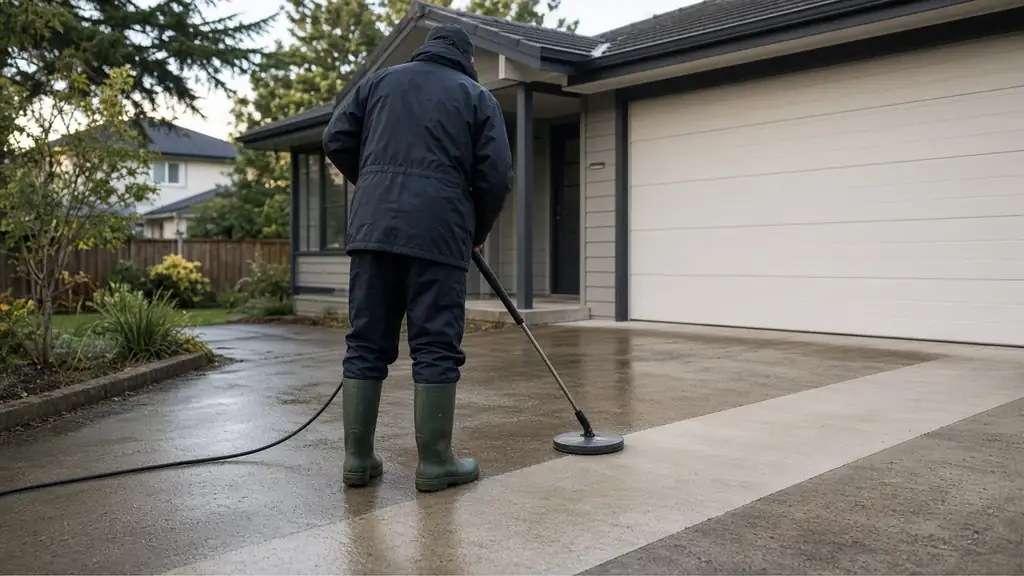
People often use "pressure washing" and "soft washing" as if they're the same thing. They're not. Use the wrong one and you can strip paint off your weatherboards or barely touch the moss on your driveway.
Here's the difference, and how to tell which one each part of your property needs.
The short version
Pressure washing uses high-pressure water to blast dirt, moss and grime off tough surfaces. In New Zealand most people call it water blasting. It's the go-to for concrete, brick and other hard, unpainted surfaces.
Soft washing uses low pressure, not much more than a garden hose, plus a cleaning solution. The solution kills mould, algae and lichen at the roots. Then it's rinsed off. It's for surfaces that high pressure would damage, like painted walls, plaster and most roofs.
One uses force. The other uses chemistry and time.
How pressure washing works
A pressure washer pumps water through a narrow nozzle at high pressure. The jet physically knocks off whatever's on the surface. On concrete, that's moss, dirt and the grey film that builds up in Auckland's damp winters.
It works fast and gets a great result on the right surface. The risk is that the jet doesn't know the difference between dirt and paint. Point it at something soft and it'll take that off too.
How soft washing works
With a soft wash, we apply a cleaning solution at low pressure across the surface. It soaks into the mould, algae and lichen and kills it. After it's had time to work, we rinse it off gently.
Because the growth is actually dead, it doesn't come back as fast as it does after a blast with plain water. And because the pressure is low, there's no risk of lifting paint, gouging timber or forcing water behind cladding. We use biodegradable solutions and protect plants while we work.
Which surface needs which?
| Surface | Pressure wash | Soft wash |
|---|---|---|
| Concrete driveway or path (over about 3 years old) | Yes | Can do |
| New concrete (under about 3 years old) | No | Yes |
| Brick paving and pavers | Yes, with care at joints | Can do |
| Painted weatherboards | No | Yes |
| Plaster, Linea and fibre cement | No | Yes |
| Brick walls | Low setting only | Yes |
| Long-run iron roof | Yes, by a professional | Yes |
| Chip-coated roof (e.g. Decramastic) | No | Yes |
| Timber deck | Low setting, with care | Often better |
| Painted or Colorsteel fence | No | Yes |
| Outdoor furniture | No | Yes |
| Windows and joinery | No | Yes |
When in doubt, start soft. You can always step up the pressure on a tough surface. You can't undo stripped paint.
Around a typical Auckland home
Take an ordinary weatherboard house in, say, Glenfield or Papatoetoe. The walls, eaves and window frames get a soft wash. The concrete driveway and front path get pressure washed. The deck gets a soft wash to kill the green algae, maybe followed by a gentle rinse at low pressure. The roof depends on what it's made of.
So most homes need both, just on different parts. That's why we carry gear for both and pick the method surface by surface.
Why not just blast everything?
It's quicker, and that's the temptation. But high pressure on a house causes problems that show up later:
- Paint lifts and flakes, especially if it's already chalky
- Soft timber gets a furry, gouged surface
- Water gets forced up behind weatherboard laps and into the wall
- Seals around windows can blow out
- Chip comes off coated roofs, shortening their life
And because water alone doesn't kill the roots, the mould grows back quickly. You end up paying for the same job again, plus repairs.
Why not just soft wash everything?
Soft washing is great for killing growth, but on hard surfaces with ground-in dirt, oil or thick moss, pressure gets a better result in less time. A concrete driveway with years of grime needs the physical scrubbing action of a pressure washer, ideally after a solution has gone on to kill the growth first.
Our pressure and soft wash services
For driveways, paths, patios and other hard surfaces, see our pressure wash Auckland page. For walls, plaster and roofs, read about our soft wash Auckland method. If it's the whole outside of the house you want done, our house wash in Auckland uses soft washing on the walls and the right method on everything else.
We cover the North Shore, West, Central, East and South Auckland and Manukau. Call us on 027 303 8398 for a free quote, seven days, 7am to 7pm.
Pressure vs soft wash questions
Is pressure washing safe for my house?
Not for the walls, joinery or most roofs. Those get a soft wash. Pressure washing is for hard, unpainted surfaces like concrete and pavers.
Does soft washing actually get things clean?
Yes. The solution kills the mould, algae and lichen, and the rinse takes it away. On houses it usually lasts longer than water blasting because the roots are killed.
Which is better for a deck?
Usually a soft wash, because it kills the algae without roughing up the timber. Some decks get a gentle low-pressure rinse afterwards.
Can you pressure wash new concrete?
Concrete under about three years old should be soft washed. High pressure can damage the surface while it's still hardening.